
Why We Design Delicate, Not Dominant: Our Design Manifesto
There's a specific moment that crystallized our entire design philosophy. I was having coffee with a customer let's call her Anjali. She'd bought one of our 12g contemporary pieces six months earlier. She was wearing it. I asked how she felt about it. She paused. Then: "It's the first piece of jewelry I forget I'm wearing. And that's exactly what I needed." I sat with that. Forget I'm wearing. That's not how people usually talk about jewelry. Usually it's: "I love how it looks." "It makes a statement." "People always comment on it." But Anjali was saying something different. The best thing about her mangalsutra was that it integrated so seamlessly into her life that it became... invisible. Not visually she got compliments constantly. But experientially. It wasn't demanding her attention. It wasn't requiring constant awareness. It just... was. That's when I understood: We're not designing jewelry that dominates. We're designing jewelry that integrates. Not pieces that announce themselves. Pieces that become part of you. This is our design manifesto. Why we design delicate, not dominant. What that actually means. And why it matters.
What "Dominant" Design Looks Like
Let's start by naming what we're NOT doing. Dominant design is: Heavy by weight Traditional mangalsutras: 40-80 grams. You feel them constantly. The weight pulls at your neck. You're always aware you're wearing substantial jewelry. The physical presence is undeniable. Large in scale. Elaborate pendants. Thick chains. Chunky elements. The jewelry takes up significant visual and physical space. It's the first thing people see about you. Demanding attention. "Look at me" design. Meant to be noticed. Conversation starter. Status symbol. The jewelry is the point not an element of your overall presentation, but the dominant feature. Restricting movement. Too heavy or bulky to wear during physical activity. Interferes with clothing (catches on fabric, shows under everything, limits what you can wear). Requires you to adjust your behavior around the jewelry. Culturally marking. Loudly signals: MARRIED. TRADITIONAL. SOUTH ASIAN. The jewelry is billboard announcing your status and cultural identity to everyone who sees you. No subtlety. Requiring special occasions. Too elaborate for daily life. You save it for weddings, festivals, special events. Not integrated into regular life. Special occasion jewelry, not daily jewelry. The underlying philosophy of dominant designJewelry as display. As status marker. As announcement. As performance. The jewelry is separate from you it's costume you put on, not element of self-expression that's integrated with who you are.
What "Delicate" Design Actually Means
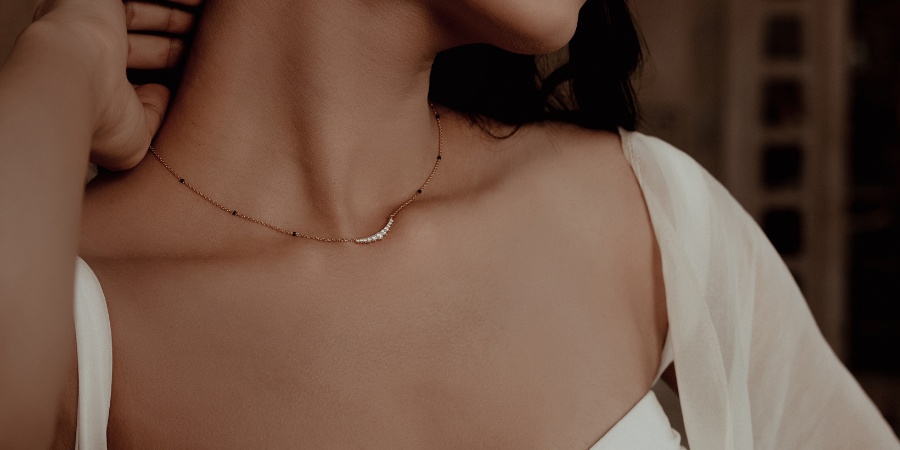
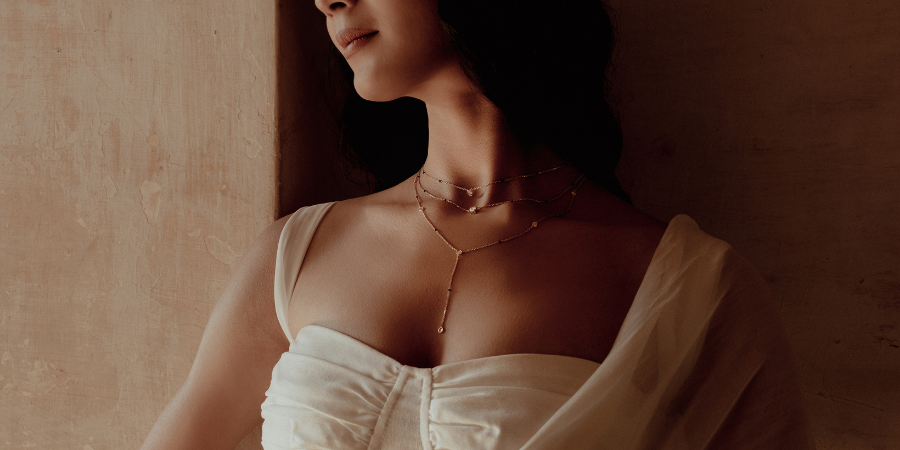
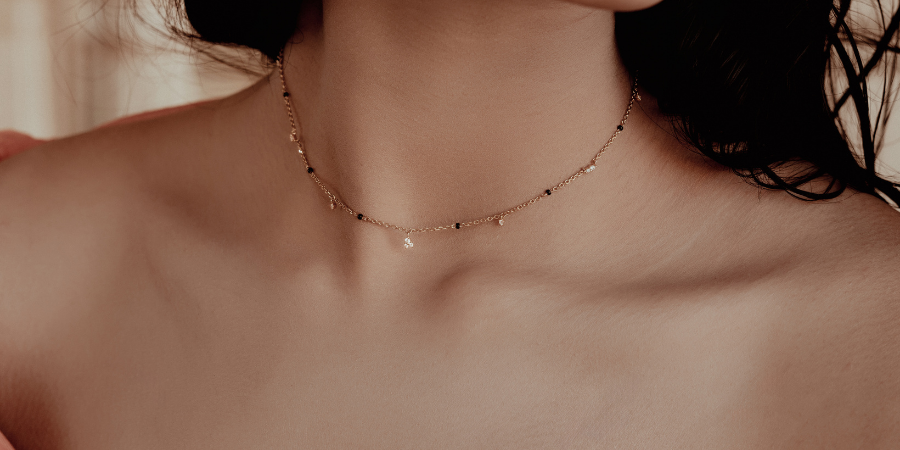
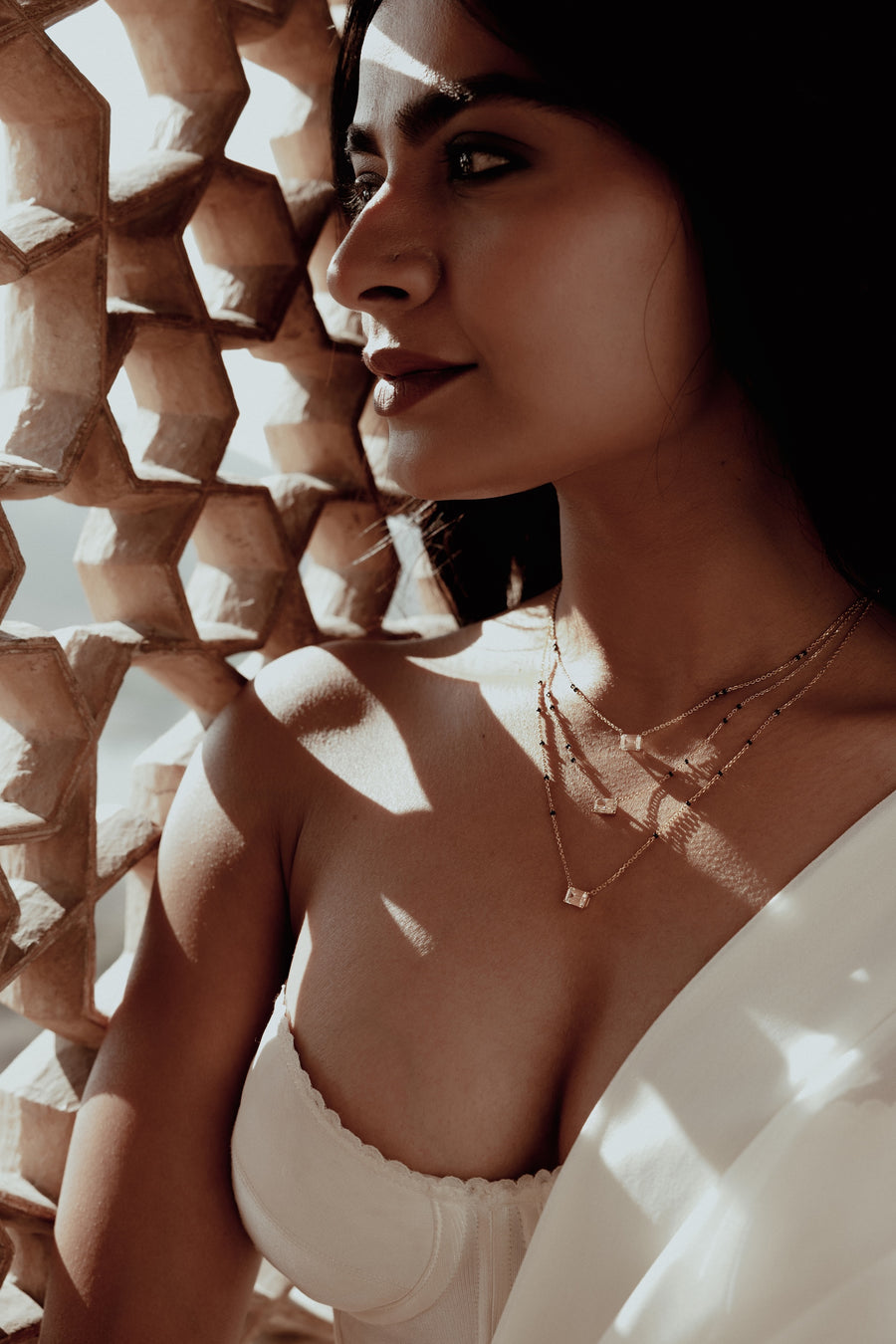
Now let me be clear: Delicate doesn't mean fragile, cheap, or insignificant. Delicate design is: Lightweight without being flimsy 8-15 grams typically. Light enough to forget you're wearing it. Substantial enough to be durable and feel quality. The weight is optimized for comfort, not for gold content maximization. Refined in scale. Proportions that work with human body, not against it. Pendant sizes that complement rather than overwhelm. Chain thickness that's elegant, not chunky. Everything is intentionally sized for harmony. Quietly confident. Beautiful without demanding attention. Noticeable when you look, but not screaming for notice. The jewelry enhances you it doesn't compete with you for attention. Understated elegance. Allowing natural movement. You can exercise in it. Sleep in it. Work in it. Live in it. The jewelry moves with you naturally. It doesn't restrict, interfere, or require accommodation. It adapts to your life. Culturally present without dominating. Maintains symbolic significance (black beads, gold, marriage marking) without being culturally loud. People who know, know. People who don't, see beautiful jewelry. Your choice when/how to explain cultural significance. Designed for daily integration. These pieces work with jeans and blazers. With saris and Western formal wear. In boardrooms and at weddings. Versatile because they're designed to integrate into varied contexts, not to stand out in one specific context. The underlying philosophy of delicate design: Jewelry as integration. As personal expression. As daily companion. As enhancement of self rather than announcement. The jewelry becomes part of you extension of your authentic presentation, not costume you perform.
The Design Principles
Our design process is guided by five principles:
Principle #1: Comfort Is Non-Negotiable.The belief: If jewelry is uncomfortable, you won't wear it. If you don't wear it, symbolism is theoretical. For jewelry to be meaningful daily practice, it must be comfortable daily. How this shows up in design: Weight optimization: Every design is engineered for minimum weight while maintaining structural integrity. We don't just make traditional designs lighter we redesign from scratch asking: What's the minimum weight that maintains durability and presence? Answer: 8-15g for most pieces. This is sweet spot where piece feels substantial (quality, not cheap) but light (comfortable for all-day wear). Balance points: Pendant weight is distributed. Chain thickness is calibrated. The piece sits naturally without pulling forward, twisting sideways, or creating pressure points. Physics of weight distribution is considered in every design. Edge smoothing: Every edge is rounded. No sharp corners. No points that catch on clothing or skin. You can sleep in our pieces comfortably they don't poke, scratch, or irritate. Chain design: Chains are designed to move fluidly. Not stiff or rigid. They drape naturally, following body's contours. The movement feels organic, not mechanical. Testing: Every design is wear-tested for 2+ weeks before finalizing. Does it cause any discomfort after hour 1? Hour 8? Day 3? Day 14? We only launch designs that pass extended comfort testing.
Principle #2: Beauty Doesn't Require Bulk.The belief: More isn't always more. Sometimes restraint creates greater beauty than abundance. Delicate can be more striking than elaborate. How this shows up in design: Negative space: We design with intentional emptiness. Space around elements is as important as the elements themselves. This creates visual breathing room. The eye has space to rest. The design doesn't overwhelm. Line refinement: Every line is considered. Thickness of chain links. Width of pendant elements. Diameter of beads. We're always asking: Can this be more refined while maintaining integrity? Usually the answer is yes. Detail work: Instead of adding more elements, we add more refinement to fewer elements. The texture of a single bead. The precise curve of a link. The finishing quality of a clasp. Excellence in execution rather than abundance in elements. Proportion: Human-scaled proportions. Pendants that relate to neck and collarbone naturally. Beads sized appropriately for modern aesthetic. Nothing oversized or out of scale with contemporary proportions. Minimalism with meaning: We strip away decorative excess but keep symbolic elements. Black beads (protection). Gold (divine feminine/prosperity). Marriage marking function. The essence remains; the excess is removed.
Principle #3: Wearability With Everything The belief: If jewelry only works with specific outfits or contexts, its utility is limited. Daily jewelry must be genuinely versatile working across wardrobes, occasions, contexts. How this shows up in design: Color neutrality: Gold (yellow, white, rose) and black. These are neutrals that work with everything. We don't add colored stones that limit color palette compatibility. Neutral foundation = maximum versatility. Style adaptability: Pieces that read as elegant with business formal, contemporary with casual, appropriate with traditional. The aesthetic is refined enough for formal contexts, understated enough for casual contexts. Cultural flexibility: Can be worn at both Indian and Western events. Works with sari blouses and blazers. Appropriate in temple and in office. The design bridges cultural contexts rather than being locked into one. Layering capability: Designs can stand alone or be layered with other pieces. They don't dominate so completely that adding other jewelry looks cluttered. This gives styling flexibility. Length options: Most designs available in multiple lengths (16", 18", 20"). Different women's preferences, different necklines, different styling approaches length options accommodate diversity.
Principle #4: Timelessness Over Trend. The belief: Mangalsutras are meant to be worn for decades. We're not designing for this season we're designing for the next 30+ years of someone's life. Timeless design is essential. How this shows up in design: Classic elements: We use design elements that have been beautiful for centuries and will remain beautiful for centuries more. Curved lines. Symmetry. Proportion. Human-scaled beauty that transcends trends. Avoiding fashion-forward: We don't chase jewelry trends. No statement necklaces. No chunky chains because they're having a moment. No designs that will look dated in 3 years. We design for longevity. Contemporary without trendy: There's difference between contemporary (clean, modern, refined aesthetic) and trendy (whatever's fashionable right now). We aim for contemporary timelessness modern but enduring. Quality materials: Real gold (14K or 18K). Real diamonds or lab-grown. No plating that wears off. No materials that degrade. The physical longevity matches the design longevity. Design restraint: We resist the urge to make designs more "interesting" through trendy elements. Sometimes the simple, refined version is the one that lasts. Restraint creates timelessness.
Principle #5: Meaning Must Be Maintained The belief: We're adapting form, not abandoning meaning. Every piece must maintain core symbolic elements that make it a mangalsutra, not just a necklace. How this shows up in design: Black beads present: Every design includes black beads (or black elements). This is non-negotiable. Black beads protection of the wearer. This symbolism is core to mangalsutra meaning. Gold required: Gold represents divine feminine energy, prosperity, auspiciousness. It's not just material it's symbolic. We use real gold (not plated, not gold-filled) because the meaning matters. Marriage marking function: The design must clearly mark marital status for those who know what they're looking at. This is the primary function of mangalsutra. Even in contemporary form, this function is preserved. Regional elements (when requested): When designing region-specific pieces, we include appropriate elements. Tamil thaali = specific pendant shapes. Maharashtrian = specific bead patterns. We don't homogeniz we respect regional specificity. Intentional adaptation, not casual modification: When we adapt an element (making beads smaller, simplifying pendant shape), we can explain why we adapted it and how the adaptation maintains symbolic essence. Nothing is changed casually.
The Design Process
Here's how these principles translate into actual design work:
Step 1: Understand the Meaning Deeply Before designing anything, we research:Traditional forms and their variations. Regional specificities. Symbolic meanings of each element. Historical evolution of the design. Religious and cultural significance. We don't design until we understand. This prevents creating something that looks like mangalsutra but misses essential meanings.
Step 2: Identify Essential vs. Peripheral For each traditional element, we ask: Is this essential to the meaning or is it decorative? What function does this element serve? Can this function be achieved in different form? What's the minimum expression that maintains the meaning?
Example: Traditional Tamil thaali: Large gold pendant with specific shape, elaborate decoration, significant weight (40-60g). Our analysis: Essential: The pendant shape (signifies Tamil tradition), gold material (symbolism), specific decorative patterns (regional identity) Peripheral: The size (can be scaled down), the weight (can be optimized), the elaborateness of decoration (can be refined) Result: Tamil-style thaali that maintains shape and pattern but at 1/3 the weight and 1/2 the size. Essence preserved, form adapted.
Step 3: Design for the Body We design on and for actual human bodies: How does piece sit on average neck/collarbone? What's weight distribution like during movement? How does it interact with different necklines? Does it stay in place or twist? Are there pressure points? Physical prototyping is required. We don't finalize designs from CAD alone. Pieces must be worn, tested, refined based on actual experience.
Step 4: Refine to Essence We iterate toward simplicity: Can this element be more delicate? Can this line be cleaner? Can this connection be more refined? What can we remove without losing meaning? The goal: Minimum effective design. Not minimal as in sparse minimal as in nothing unnecessary, everything that's there serves purpose.
Step 5: Test for Longevity. Before launch, we ask: Will this design feel dated in 5 years? 10 years? Will I be embarrassed by this design in 2035? Would this have been beautiful in 2005? Will it be in 2045? Is this contemporary or trendy? If there's doubt about longevity, we don't launch. We'd rather release fewer designs that endure than more designs that are disposable.
Step 6: Validate With Community Before finalizing, we show designs to: Existing customers. South Asian women in target demographic. Cultural experts when needed for region-specific designs Women who've worn traditional mangalsutras We listen to feedback. Especially: "This doesn't feel right culturally" or "This wouldn't work for my life because..." We adjust based on this input.
Why Delicate Design Matters
This design philosophy isn't just aesthetic preference. It has real impact:
Impact #1: Women Actually Wear Their Mangalsutras The problem: Traditional heavy mangalsutras end up in vaults. Women can't/won't wear them daily. Our solution: Delicate design that's comfortable and versatile enough for daily wear.The mangalsutra becomes daily practice, not special occasion performance. The result: Our customers wear their pieces daily. The symbolism is lived, not theoretical. The tradition is practiced, not abandoned.
Impact #2: Cultural Symbols Integrate Into Modern Lives The tension: Women want to honor tradition while living contemporary lives. Heavy traditional jewelry creates forced choice: tradition OR modern life. Our approach: Delicate design that works in modern contexts. You can wear your mangalsutra to the boardroom, the gym, the wedding. It integrates rather than conflicts. The resolution: Both/and becomes possible. Tradition AND modern life. Cultural symbol AND contemporary aesthetic. No forced choice.
Impact #3: Tradition Survives Through Evolution The reality: Traditions that don't adapt often get abandoned entirely. Next generation looks at 60g mangalsutras and says "not for me." Our intervention: Delicate contemporary designs show that tradition can evolve while maintaining meaning. Adaptation becomes possible, preventing complete abandonment. The impact: Tradition survives into next generation because it's been made relevant. Women can practice tradition in forms that work for them.
Impact #4: Women Reclaim Agency The dynamic: Heavy traditional jewelry often feels imposed. Women receive it, feel obligated to wear it, resent it. Our shift: Delicate designs women choose for themselves. They're active agents selecting jewelry that works for their lives, not passive recipients of jewelry that doesn't. The empowerment: Choosing jewelry = choosing how to engage with tradition. Agency over cultural practice. This matters profoundly.
Impact #5: Beauty Becomes Sustainable Traditional approach: Elaborate, heavy, expensive jewelry worn rarely. Beautiful but impractical. High cost per wear because pieces sit unused. Our approach: Delicate jewelry worn constantly. Beautiful and practical. Low cost per wear because pieces are used daily. The sustainability: Both environmental (less gold used) and economic (better value through constant use). Sustainable beauty.
Common Questions About Our Design Philosophy
"Isn't delicate jewelry less special/significant?" No. Delicate ≠ less meaningful. A 12g thoughtfully designed piece worn daily is more significant than a 60g piece sitting in a vault. Significance comes from: Symbolic meaning (maintained in our designs) Personal connection (stronger when you actually wear it) Conscious choice (you chose this specific piece) Daily practice (wearing becomes meditation on commitment) Weight doesn't determine worth. Meaning and use do. "Will delicate jewelry last as long?" Yes, when designed properly. Our pieces are engineered for durability: Reinforced connection points Quality materials (14K or 18K gold, not 22K which is softer) Proper thickness (delicate but not fragile) Professional construction techniques. A well-made 12g piece will outlast a poorly-made 50g piece. It's about engineering and quality, not just weight. "Doesn't traditional design have cultural authenticity that contemporary lacks?" Authenticity is about meaningful engagement, not unchanging replication. Traditional designs were contemporary adaptations in their time. They evolved based on available materials, manufacturing techniques, aesthetic preferences of their era. Contemporary designs that maintain symbolic meaning while adapting form for current context are continuing that evolution. They're authentically engaged with tradition, not blindly replicating it. Mechanical replication without understanding is less authentic than conscious adaptation with deep meaning comprehension. "Are you designing for Western audience rather than South Asian?" We're designing for South Asian women living contemporary lives. Many live in West (diaspora). Many live in India but have contemporary lifestyles. Modern life isn't Western life it's global reality. We're not Westernizing. We're adapting for modern context that many South Asian women actually inhabit. That's serving our community, not abandoning it."Won't older generation disapprove of delicate designs?" Some will. That's okay. We're not designing for older generation's approval. We're designing for the women who will wear these pieces. Older generation had jewelry that worked for their lives. Current generation deserves jewelry that works for theirs. Respect for elders doesn't require wearing jewelry that hurts us or doesn't fit our lives. We can honor them while making different choices.
To the Designer, Jeweler, or Brand
If you're designing cultural jewelry: Understand before you design: Deep cultural knowledge is prerequisite. You can't adapt what you don't understand. Research the meanings, the symbolism, the regional variations, the religious significance. Design for the body: Actual human bodies wearing jewelry in actual contexts. Not just aesthetic object on white background. How does it feel? How does it move? How does it integrate? Prioritize wearability: Beautiful but unwearable jewelry ends up unused. Wearability isn't compromise on beauty it's prerequisite for relevance. Adapt with intention: Know WHY you're changing each element. Casual modification shows. Intentional adaptation with maintained meaning is what works. Test extensively: Wear prototypes for weeks. Get feedback from target users. Iterate based on actual experience, not just visual design. Design for longevity: This jewelry should be beautiful in 30 years. Ask: Will this date? Will this endure? Design beyond trend. Respect the culture: If it's not your culture, partner with cultural insiders. Don't appropriate, adapt, or innovate cultural jewelry without deep respect and understanding.
Our Commitment
Modern Mangal commits to delicate design: We will never: Make jewelry that prioritizes gold weight over wearability Chase trends at expense of timelessness Strip symbolic meaning for aesthetic simplification Design for display over daily integration Create pieces that require your life to adapt to jewelry rather than jewelry adapting to your life We will always: Prioritize comfort and wearability Maintain core symbolic meanings Design for lasting beauty, not temporary fashion.Engineer for durability despite delicate aesthetic Test extensively before launch. Listen to community feedback. Evolve as we learn This is our manifesto. This is what we build. This is why we design delicate, not dominant. Because jewelry that integrates into your life serves you better than jewelry that dominates it. Because tradition practiced daily is more meaningful than tradition stored away. Because you deserve beautiful jewelry you actually want to wear. Delicate. Not dominant. Always.